
Voice search is enabled by voice recognition technologies like Siri, Google Assistant, and Alexa. Conversational commerce means that voice assistants and messaging apps help people to shop, order, and get support. It includes chatbots that answer product-related queries, personalized recommendations through chats, and order confirmation through voice or text. Together, these technologies are designing a future where connecting with brands becomes child’s play.
Our client, a fast-growing organisation located in the USA, was facing obstacles, as without voice search and conversational commerce, users had to navigate menus and search bars, which reduced user satisfaction, and mainly elderly users were not able to interact easily. As we know, voice-driven experiences are more interactive and personalised. Not accepting a voice search could leave your brand behind. With the help of Voice Search and Conversational Commerce, they were able to interact with tech-savvy and convenience-seeking customers.
Without Voice Search and Conversational Commerce, users must navigate menus, search bars, and forms that decrease customer satisfaction. Here’s a list of challenges users face without voice search and conversational commerce.

Voice commerce is growing rapidly and not supporting it means losing tech-savvy or convenience-seeking customers. Voice-driven experiences are more interactive and personalized and not accepting voice search could leave your brand behind.

Without voice search users need to type or tap, which is time-consuming as it takes time to browse or perform product searches manually.

Users with disabilities or low digital literacy may find it difficult to shop or search without voice search or conversational commerce.

Voice assistants can act as virtual support agents. Without them, users depend on slower live chat or emails.
Over 50% of online searches are voice-based, and the number is only increasing, with no signs of slowing down. Through messaging apps, conversational commerce works. Examples are WhatsApp, Facebook Messenger, Instagram etc. It builds trust and creates a beautiful customer journey as these technologies are more intuitive and simplify the buying process.

These technologies are making the conversation with customers easy, fast, and reliable.

Voice Search and Conversational Commerce is a part of e-commerce where the interaction feels seamless between the brand and the consumer.

Consumers' way to shop, buy, and order is changing rapidly. With an increase in smart devices like Google, Alexa, and Siri, there is a new road for businesses to interact with their customers.

Local businesses allow WhatsApp to place orders and provide customer support immediately. Shopping apps interact with chatbots for product knowledge and order tracking.
Voice search and conversational commerce involve voice-enabled technologies, NLP (natural language processing), and AI-powered systems to enhance how users search and buy online through spoken communication. Here’s a breakdown of how both the technologies are implemented:

Voice Search allows users to speak their queries instead of typing.
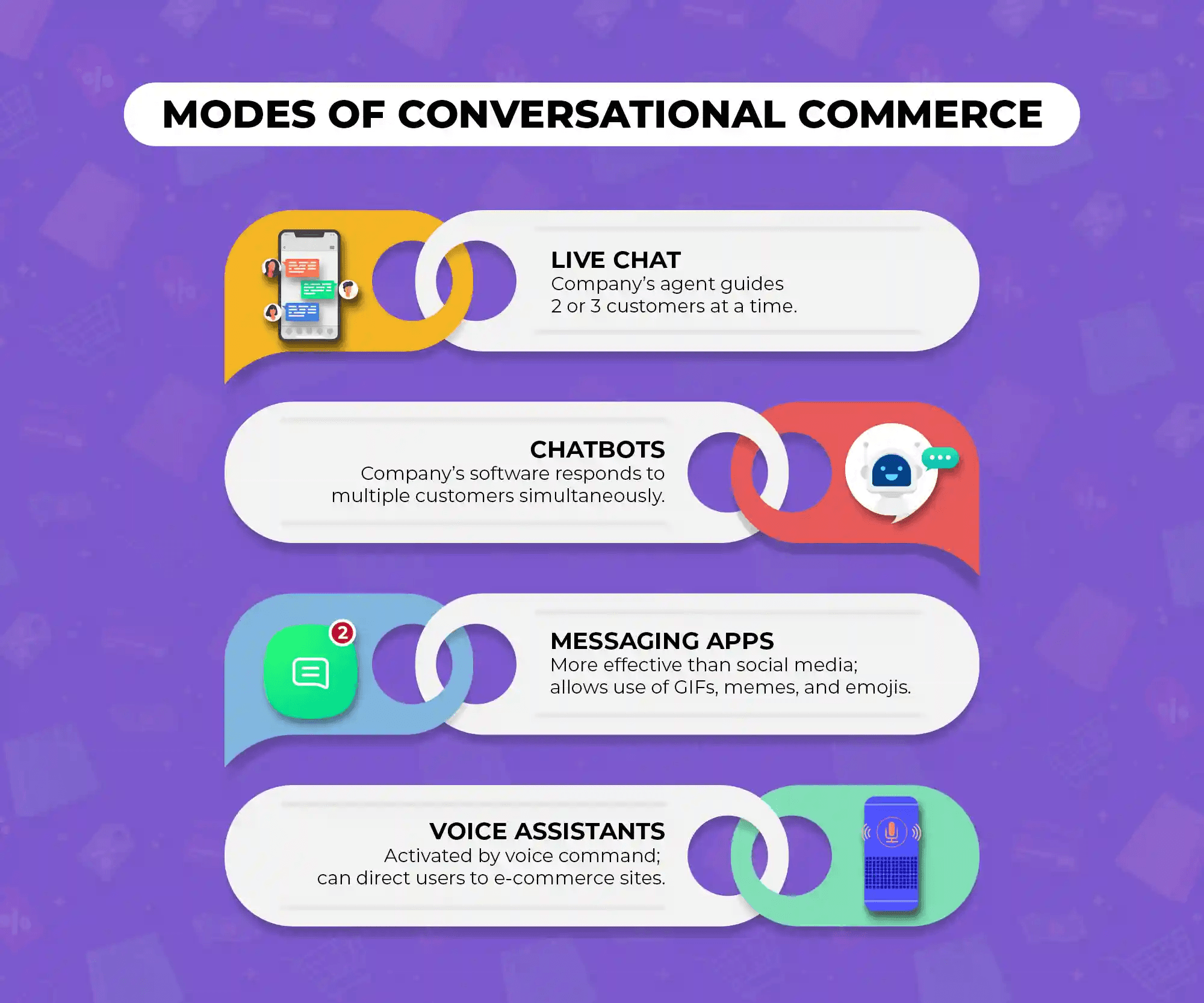
Conversational Commerce allows users to browse, find, and buy products through chats or voice interfaces.

AI uses previous data, preferences, and behaviour to personalize the experience.

Voice Assistants like Alexa and Google Assistant allow users to place orders via voice.
Voice Search and Conversational Commerce are changing how businesses communicate with consumers across industries by giving personalized experiences in reality. Here’s a complete breakdown of their industry applications:

Voicebots answer queries, assist patients in booking appointments, and provide health updates.

Conversational bots answer credit card queries, balance checks, and loan information via voice.

Voice-enabled hotel bookings, real-time flight status, boarding pass delivery, and in-room assistant services.

Conversational quizzes, language learning, and voice-guided teaching via bots.
Voice Search enables users to speak their needs instead of typing them. It is effective, convenient, and builds trustful customer relationships while accelerating buying decisions.

Voice Search is becoming more effective, convenient, and appropriate.

Building trust with customers and creating a smooth customer journey.

Simplifies the buying process and improves communication speed.

Businesses can find out how their products could be searched for or ordered via Alexa or Google Assistants.
Hence, voice search refers to using spoken language (rather than typing) to search the Internet or communicate with devices. You ask a question like: “What's the day today?” The system converts speech to text using ASR (automatic speech recognition). It processes the query using NLP (natural language processing). Then it gives the result on screen or speaks it back to you. Tools like Drift, Intercom guide purchases and offer immediate support. Voice and chat messages make the purchasing process seamless.